





How to Safely Display Antiques: Lighting, Humidity & Security Tips for Your Display Cabinet
2026-06-16 11:33:07
Click:
“
Practical, conservation-first guidance on configuring your display cabinet for antiques — including optimal LED lighting specs, RH/temperature monitoring, vibration damping, and tamper-resistant locking systems.
”
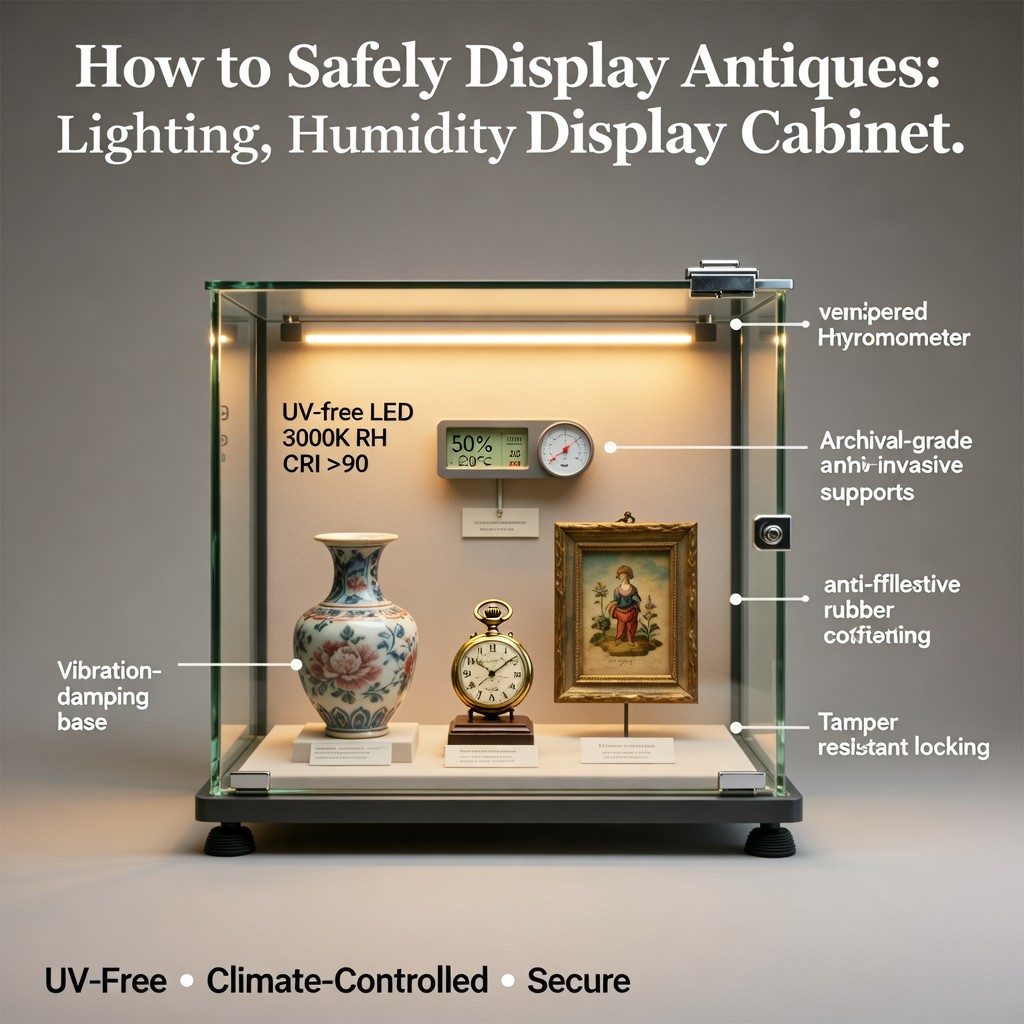
Lighting: Prioritize UV-Free, Low-Heat Illumination
Lighting is among the most critical yet often overlooked factors in antique display safety. Prolonged exposure to ultraviolet (UV) radiation and infrared (IR) heat accelerates fading, embrittlement, and pigment degradation—particularly in textiles, paper, pigments, and organic materials. To mitigate this risk, specify LED fixtures rated for museum-grade use: color temperature between 2700K–3500K (warm white), Color Rendering Index (CRI) ≥95, and certified UV emission<10 µW/lm. Ensure all LEDs are fitted with UV-absorbing acrylic diffusers or housed behind UV-filtering glass (e.g., Optium Museum Acrylic®). Avoid track lighting with unshielded bulbs, halogen sources, or any fixture generating surface temperatures above 30°C near sensitive objects.
Humidity Control: Maintain Stable Relative Humidity & Temperature
Fluctuating relative humidity (RH) is a primary driver of dimensional stress in wood, ivory, parchment, and composite antiques—leading to warping, cracking, delamination, and mold growth. Ideal RH for mixed-media antique collections lies within 40–55%, with diurnal variation held to ±5% maximum. Pair a calibrated digital hygrothermograph (NIST-traceable, data-logging capability) with passive or active climate control: silica gel desiccant systems for small cabinets, or integrated microclimate modules (e.g., Meopta MicroClimate or Image Permanence Institute’s BufferBox™) for larger enclosures. Avoid placing cabinets near HVAC vents, exterior walls, or windows where thermal bridging induces condensation. Ambient room temperature should remain stable between 18–22°C; avoid extremes below 15°C or above 25°C.
Security & Structural Integrity: Integrated Anti-Theft and Vibration Mitigation
A secure display cabinet must balance accessibility with robust physical protection. Tamper-resistant locking mechanisms—such as dual-point deadbolts with hardened steel strike plates, electromagnetic locks with battery backup, or biometric access controls—should be installed on all hinged or sliding panels. Glass must meet ASTM F1233 impact resistance standards (minimum 6 mm laminated or tempered glass with PVB interlayer); for high-value items, consider bullet-resistant or blast-rated glazing. To prevent micro-vibrations from footfall, HVAC operation, or nearby traffic, mount cabinets on vibration-damping platforms—e.g., Sorbothane® isolation pads or pneumatic isolators—with independent anchoring to structural floors. Avoid freestanding units on carpeted or suspended floors without seismic bracing.
Archival Mounting & Internal Configuration: Non-Invasive Support Systems
Mounting hardware and internal substrates must adhere strictly to conservation ethics: no adhesives, nails, or pressure-sensitive tapes may contact original surfaces. Use inert, pH-neutral materials only—such as acid-free mat board (buffered, 100% cotton rag), ethafoam® (polyethylene foam), or Tyvek® supports secured with stainless-steel pins or custom-machined acrylic cradles. Objects should rest fully supported—not cantilevered—and weight distribution must avoid localized stress points. For framed works, employ conservation-grade framing techniques: backboards of corrugated polypropylene, perimeter sealing with archival tape, and spacers ensuring no contact between glazing and artwork surface. All mounting components must be documented, reversible, and mechanically adjustable without tooling.
Ongoing Monitoring & Preventive Maintenance Protocol
Conservation is not a one-time setup but an ongoing stewardship practice. Install wireless environmental sensors logging RH, temperature, light intensity (lux), and UV index at object level—review data weekly and calibrate quarterly. Inspect seals, gaskets, locks, and mounts every three months; replace desiccants per manufacturer schedule. Clean glazing using deionized water and lint-free cellulose cloths—never ammonia-based cleaners or abrasive pads. Maintain a detailed logbook recording all adjustments, environmental anomalies, and condition observations—this documentation supports insurance compliance, provenance integrity, and future conservation assessment.










Shenzhen RuiCloneCity Exhibition Co., Ltd.
WhatsApp:
+86 13714228883
E-mail:
cenghuil98@gmail.com
Address:
No.1 Chuangye 3rd Rd, Hongtengyuan Sci-Park, Mapu Ind. Park, Fenggang, Dongguan, Guangdong
Copyright © 2026 Shenzhen RuiCloneCity Exhibition Co., Ltd. All Rights Reserved.
